
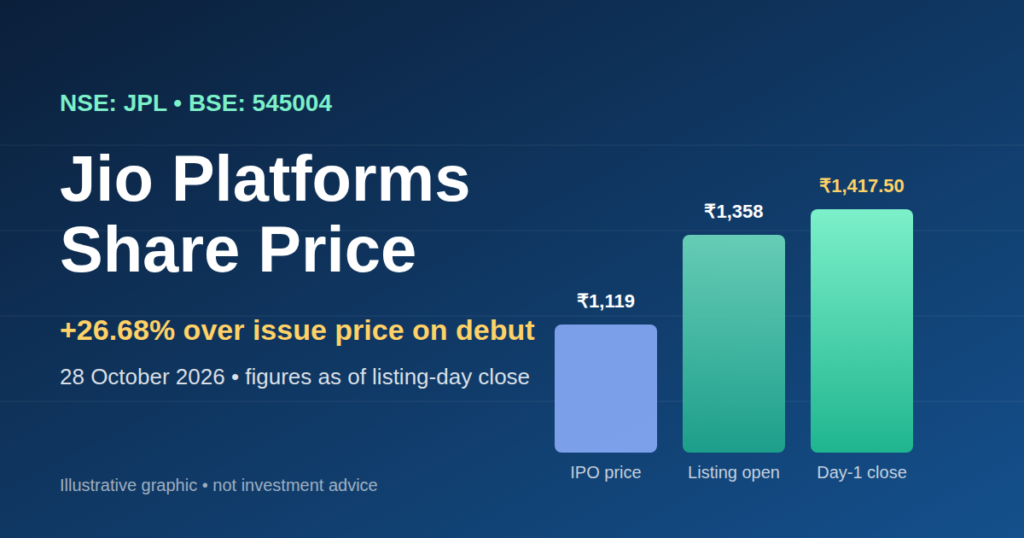
When Jio Platforms opened for trading on Wednesday, 28 October 2026, the first print on the screen was ₹1,358. By the closing bell the stock was hovering around ₹1,417.50 on the NSE. That is a gain of roughly 27% over the IPO price in a single session. This piece walks through the numbers, the arguments for and against the current valuation, and the dates that matter over the next few days. Everything below reflects data up to the listing-day close. I could not find a verified live price for 29 October, so check your broker app or the exchange website for today’s quote.
The numbers from day one
Jio trades under the ticker JPL on the NSE and under scrip code 545004 on the BSE. Here is how the first session went, based on exchange data republished by INDmoney:
- Issue price: ₹1,119, the top of the offer range. Wikipedia lists the band as ₹1,065 to ₹1,119.
- Opening price: ₹1,358, which was also essentially the day’s low at ₹1,357.
- Day’s high: ₹1,423.90.
- Close: ₹1,417.50, up ₹298.50 or 26.68% from the previous close of ₹1,119.
The shape of the day matters more than the headline. The stock never traded below its opening level. Early in the session it drifted sideways for a while, and then buyers took over and pushed it steadily up. For a ₹30,213 crore issue, that kind of absorption of supply on day one is a decent sign of demand. It does not guarantee anything about day ten or day one hundred.
A word on the headline percentage. Different outlets quoted different figures for the same session. CNBC described a debut gain of about 21.5%, which is the opening premium, while the 26.7% figure is the full-day move. Both are correct, just measured at different moments. When you read other coverage, check which one is being used.
How big is the company now?
At the closing price, Dhan’s quote page shows a market capitalisation of ₹13,05,380 crore. At the opening price, CNBC put the figure at 12.5 trillion rupees, or about $131 billion. That makes Jio the second most valuable listed company in India, behind its own parent, Reliance Industries.
It is worth remembering what the market is paying for. Telecom is the core of the business. Reuters-linked reporting earlier this year noted that roughly 75% to 80% of Jio Platforms’ annual revenue comes from telecoms. So when you buy JPL, you are mostly buying a bet on mobile and broadband economics, with the AI, cloud and satellite story layered on as an option on the future.
Brokers were behind the market
Before the listing, three brokerages had published targets for the stock. According to a Univest analysis of the debut, those were Elara Capital at ₹1,367, Motilal Oswal at ₹1,350 and Nomura at ₹1,340, all with Buy ratings. Motilal Oswal also sketched a bull case of ₹1,690 and a bear case of ₹1,035. The closing price of ₹1,417.50 sits above all three base-case targets and well inside the range between the bear and bull scenarios.
That does not mean the analysts were wrong. Targets set before a listing are educated guesses made without a market price to anchor them. The more useful question is whether they revise upward after seeing real demand, and on what reasoning. Fresh notes are likely to land in the next few days, so that is one thing to watch.
There is also an older reference point. Last October, ICICI Securities estimated that Jio Platforms could be valued at around $148 billion by the time it goes public. The market cap at the close is somewhat below that, which gives bulls an argument that the stock is not obviously stretched against earlier expectations. Bears will point out that estimates made a year ago were built on assumptions that may or may not hold.
What could move the price next
Q2 results on 30 October
This is the nearest catalyst. The quarterly numbers will be the first Jio publishes as a listed company, according to market coverage, and analysts will likely use them to reset their forecasts. Pay attention to average revenue per user, subscriber additions and capital spending, because those drive the narrative far more than a single quarter’s profit.
A tariff hike
Nomura expects a mobile tariff increase in the third quarter of the 2026-27 financial year, as reported by Univest. A price increase flows almost directly into revenue per user, which is why every telecom investor watches for it. If the hike is delayed, estimates could come down. If it arrives on schedule, it supports the current price.
Index inclusion, but not yet
Many investors assume a stock this large will join the Nifty 50 right away. That is not how it works. A new listing generally has to meet conditions first, including the introduction of futures and options contracts, and analysts quoted by Univest expect that to take several months. On CNBC, wealth manager Deven Choksey said some early investors who bought into Jio around 2021 may want to exit in roughly six months, and by then the stock would likely be in the MSCI index and the Nifty 50, which could generate enough demand to absorb that supply. That is one analyst’s view rather than a certainty, and the lock-in terms for pre-IPO holders are something I could not verify, so check the offer documents before relying on that timeline.
The Reliance link
Reliance Industries fell on the same day that Jio rose, according to Univest’s coverage, which shows the two stocks can now diverge. Religare Securities has argued that having Jio’s value visible in the market could narrow the holding-company discount applied to Reliance. In plain terms, when a parent owns a listed subsidiary, investors often value the parent at less than the sum of its parts. A clean market price for Jio gives investors a cleaner way to judge that gap.
The risks worth taking seriously
Profit booking. After a quick 26% gain, some allottees will sell. Early-session volatility in new listings is normal, and a pullback does not necessarily say anything about the business.
Valuation. The stock has already moved past the pre-listing targets. Future returns depend on earnings growth justifying a higher price, not on the listing excitement repeating itself.
Market conditions. On the day of the debut, the broader market was shaky. Univest reported that the Sensex fell by as much as 995 points in the morning amid crude oil above $115 and foreign investor selling. A weak market can cap even a strong stock.
Competition and regulation. Indian telecom pricing is closely watched by regulators and contested by rivals. Any change in the rules or a price war could hit margins.
Data quality. This one is easy to overlook. When I compared quote pages, they disagreed on basic details. Trading volume was reported as about 17.73 crore shares on one page and 194.1 million on another. The upper circuit limit was shown as ₹1,629.60 on one site and ₹2,238 on another. Small mismatches like this usually come from how each site handles a newly listed stock, but they are a good reminder to rely on the NSE and BSE directly for anything you act on.
What the first day does and doesn’t tell you
A strong debut tells you that demand at the offer price was high and that buyers were willing to pay more once trading began. It does not tell you what the business is worth, how the next quarter will go, or whether the price will hold. Newly listed stocks can swing in either direction for weeks while the market looks for a stable level.
For people who received shares in the IPO, the reasonable choices are the usual ones: hold for the long term, sell part to lock in a gain, or sell everything. The right answer depends on why you applied in the first place. For people who did not get an allotment, the entry price is now higher than what allottees paid, and some prefer to wait for a pullback or build a position gradually instead of buying all at once. I am not recommending any of these. They are simply the options investors typically weigh.
Key dates and things to check
- 30 October 2026: Q2 results, the first as a listed company.
- The coming days: Fresh broker notes and any revisions to price targets.
- Q3 of FY27: The expected window for a possible tariff hike, per Nomura.
- Several months out: Possible derivatives introduction and, after that, index inclusion.
- Anytime: Official price, volume and circuit data on nseindia.com and bseindia.com.
The bottom line
JPL closed its first day at ₹1,417.50, about 26.7% above the ₹1,119 issue price, with a market value of roughly ₹13 lakh crore. The next few days will show whether that level holds once the results arrive and brokers update their views. Whatever happens, one strong session is not a verdict on the company. Treat the first-day number as a starting point and judge the stock on earnings, pricing power and how much growth you think is already baked into the price.
Disclaimer: This article is for information and education only and is not investment advice. Prices change constantly, and the figures here were accurate to the best of my knowledge as of the 28 October 2026 close. Investing in securities is subject to market risk. Verify data on official exchange websites and consult a SEBI-registered adviser before making decisions.